How I Use a Monthly English Bucket List with My Family (and How You Can Too)
Learning English doesn’t have to mean worksheets, forced lessons, or stress at the kitchen table. There is sometimes enough of that with other subjects!
For my family — and for the families I work with through Outdoor Bilingual Learner — the challenge isn’t what to learn, but how to weave English naturally into everyday life in a calm and joyful way.
(Read more about my approach here: https://outdoorbilinguallearner.com/aboutrachel/)
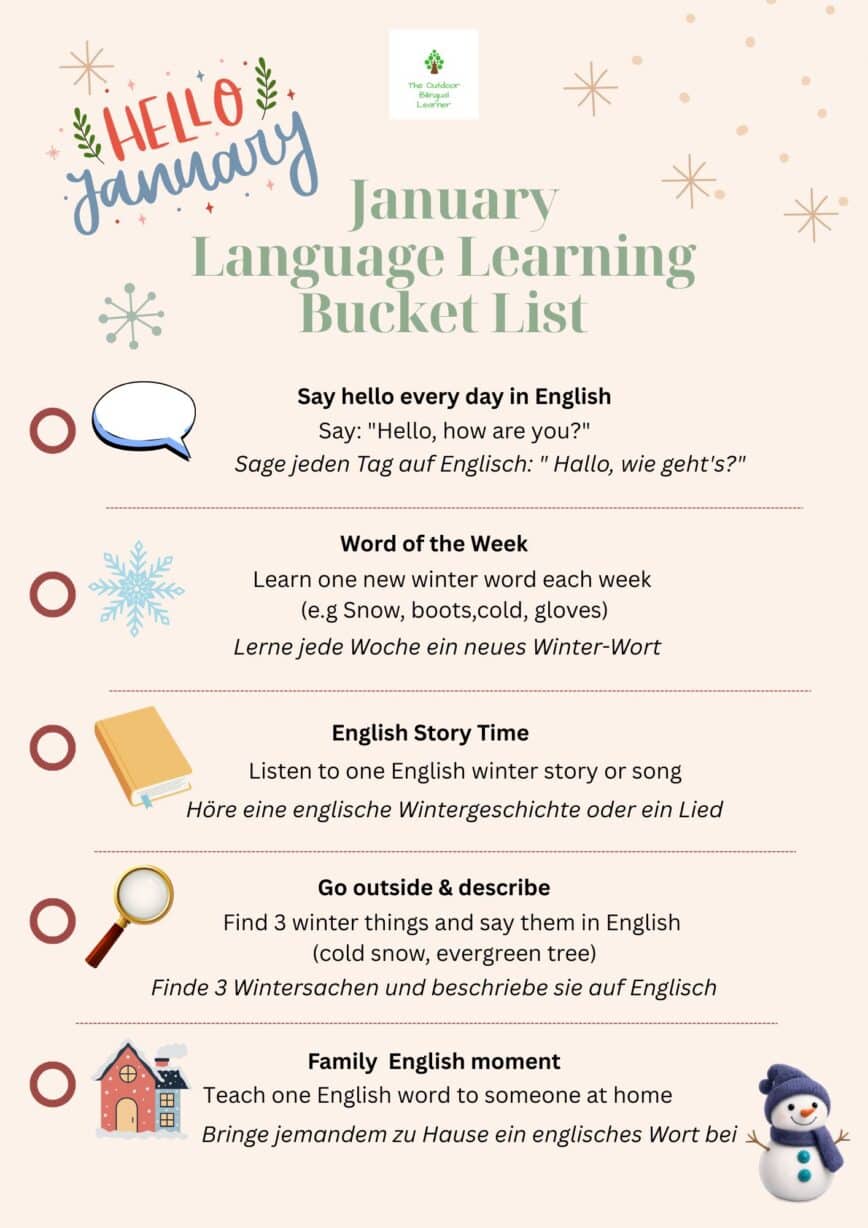
That’s exactly why I am using monthly English bucket lists. They are simple, playful, curriculum-aligned and work beautifully for both school families and homeschoolers.
WHAT IS A MONTHLY ENGLISH BUCKET LIST?
A monthly English bucket list is a one-page guide with small, achievable language activities that children complete over the course of a month.
Instead of long lessons, children experience real English moments:
– saying a sentence out loud
– learning new words
– listening to an English story
– describing something during everyday life or outdoors
This reflects how children naturally learn languages — through repetition, context and enjoyment. And if you have been reading my blog for a while you know I am all about the Chartlotte Mason inspired approach of learning a language like we do our native tongue through listening and speaking and not through writing.
(You may also enjoy this article on creating a gentle language routine: https://outdoorbilinguallearner.com/creating-a-language-learning-routine/)
WHY THIS WORKS SO WELL FOR AUSTRIAN/GERMAN FAMILIES
In Austrian and German primary schools, English focuses on:
– listening and speaking
– basic everyday vocabulary
– communication rather than correctness
– confidence and enjoyment
A bucket list supports this perfectly by:
– encouraging full sentences
– using real-life language
– avoiding grammar pressure
– allowing children to progress at their own pace
You can find an overview of English learning goals in Austrian primary schools here:
https://www.oebv.at/magazin/englisch-nach-lehrplan-unterrichten
HOW I USE THE JANUARY ENGLISH BUCKET LIST AT HOME
1. Keep it visible
We print the bucket list and place it somewhere visible, like the fridge or a learning corner.
2. One activity per week
There is no rush. One small English activity per week is more than enough in the beginning.
3. Use English in real moments
During walks, while getting dressed, at bedtime or during family conversations.
(I share many outdoor language ideas here: https://outdoorbilinguallearner.com/tag/learning-english/
4. Celebrate progress
When the list is complete, we colour in the badge and talk about what was most fun.
You can follow our bucket activites on our Instagram Account, which you can see at the bottom of this blog.
USING THE BUCKET LIST FOR HOMESCHOOLING
For homeschooling families, the bucket list is also a gentle documentation tool:
– tick off completed tasks
– note new vocabulary
– record spoken sentences
– add drawings or reflections
This works beautifully alongside a language learning notebook:
https://outdoorbilinguallearner.com/how-to-organise-your-new-language-learning-notebook/
ADAPTING FOR AGES 7–12
Younger children (7–9):
– do activities together
– focus on listening and repeating
Older children (10–12):
– encourage independent speaking
– add short descriptions
The same bucket list works for both — just with different depth.
A GENTLE, SUSTAINABLE WAY TO LEARN ENGLISH
English learning doesn’t need to be overwhelming.
With a monthly bucket list:
– children feel capable
– parents feel supported
– English becomes part of everyday life
Little and often.
Calm and meaningful.
Just as language learning should be.
If you’d like to explore this approach further, my book “The Outdoor Bilingual Learner” shares practical ideas for families:
https://outdoorbilinguallearner.com/book/